My thoughts this week have been on how simple classical singing is and how complicated singing teachers can make it. Here are a couple of quotes on this subject.
If the scale, power, quality, and compass of the human voice were established as are those of the piano, the great problem in the training of a singer would be much simplified, possibly eliminated; but the singer must form the pitch, power, and quality of each tone as he uses it; therefore in the training of a singer we are constantly facing what has crystalized into the term Voice Placing.
This term has been used as a peg upon which to hang every whim, fancy, formula, and vocal vagary that has floated through the human mind in the last two centuries. It has furnished an excuse for inflicting upon vocal students every possible product of the imagination, normal and abnormal, disguised in the word Method, and the willingness with which the students submit themselves as subjects for experiment is beyond belief. The more mysterious and abnormal the process the more faith they have in its efficacy…
…Now voice placing means just one thing, not half a dozen. It means learning how to produce a beautiful tone.
Clippinger, D.A. The head voice and other problems: practical talks on singing. Page 3.
What I find most appealing about the technical principles I have learned is that they are few and simple.
Pilotti, Katarina. The Road to Bel Canto. On my re-training to Chiaroscuro. Masters Thesis. Page 51.
This week, I have reflected upon the imagery/sensation descriptions that teachers use and whether or not these descriptions are helpful. For example, ‘place it forward’, ‘drinking sensation’ and ‘you feel the note here’. My conclusion is that this imagery did not help me! It confused me and, even worse, caused a manipulation of the sound that is unhelpful and unnecessary.
Here is an example of how simple mechanics has led me in the right direction more than imagery/sensation.
This week, I managed to significantly ‘close down’ my mouth when I sing. (My big wide open mouth has destroyed so much of my control and sound.) I achieved this smaller and more relaxed mouth not through ‘relax your tongue’, ‘make sure it is flat with a little curve here’, ‘sing like an idiot’ or ‘be like a ventriloquist’. Rather, I have achieved this through my studies of historical vocal pedagogy and realizing that I need to build up a ‘system’ that is integrated and common sense.
Luckily, a year in a Covid-19 Lockdown is helping me with this retraining because Bel Canto requires 100% awareness and concentration. It also requires compassion.
Anyway, back to the ‘closing of the mouth’.
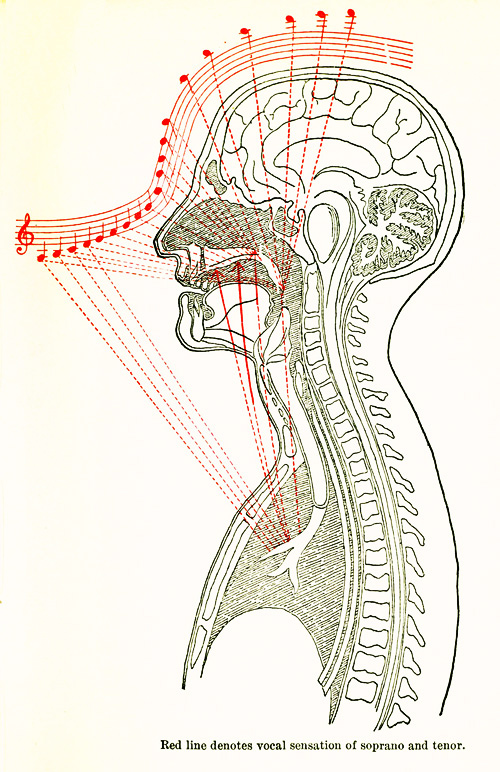
I have been using the pencil in the mouth ‘cure’ suggested by Garcia together with a combination of simple Bel Canto techniques. These simple techniques (support, lowered larynx and chiaroscuro) together with the pencil in the mouth, have produced the sensations that I am singing from ‘above’ and that the tones resonate in different parts of my skull like the Lilli Lehmann diagram. Now, for years I have battled to find these sensations because the imagery/sensations were described to me by my teachers before they fully and methodically dealt with the mechanics which produce the imagery/sensations. In other words, they put the cart before the donkey. It has taken a year of daily hard work in solitude for me to achieve the sound you hear in the SoundCloud demo below. I didn’t use imagery/sensation at all this year. I focussed on simple mechanics.
To reiterate, the mechanics lead to the imagery/sensations described in Lilli Lehmann’s picture. Not the other way around. Here is the SoundCloud audio file of how the voice floated upwards when the pencil was in the mouth.
Here is a diagram from Lilli Lehmann’s book ‘How to Sing’ so we can look at it one more time. The value in this diagram for me is that now, after pulling together a framework for myself, I can ‘check in’ whether or not I am on the right path. This is what I felt in this SoundCloud audio, so, maybe I am. Perhaps there is some value in imagery/sensations after all?
*This blog is part of my three year ‘project’ that I have called ‘The Lilli Lehmann Project’. The goal is to learn how to become a Bel Canto singing teacher.
 Deborah Wai Kapohe